


Hydraulic oil analysis is an important condition monitoring and predictive maintenance service used to evaluate the cleanliness, physical condition, chemical condition, and potential wear indicators of hydraulic fluid.
Hidroman provides hydraulic oil analysis services for industrial machinery, mobile equipment, construction machinery, mining equipment, power units, and other hydraulic systems. Depending on the application, hydraulic fluid samples can be evaluated for particle contamination, water content, viscosity, acid number, wear debris, and other oil condition parameters.
The objective is not simply to test the oil. It is to use oil analysis data to help identify changes in hydraulic system condition, evaluate contamination control, and support maintenance decisions.
Don't wait for a hydraulic failure to investigate the cause. Use oil condition data to support proactive maintenance.
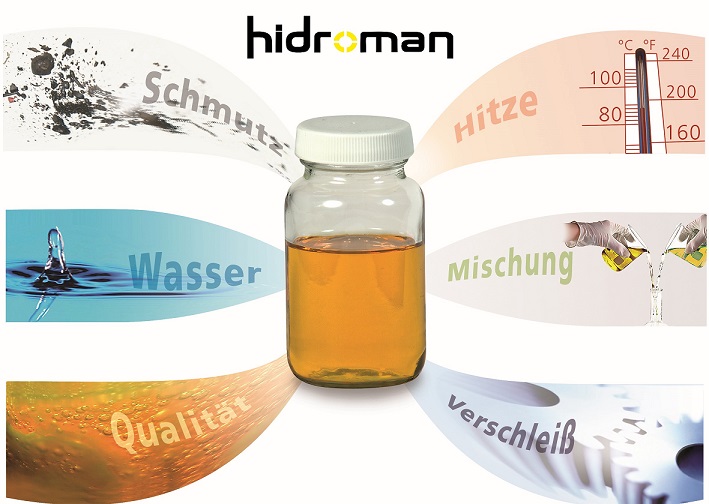
Hydraulic fluid does more than transmit power. It also lubricates and protects critical components such as hydraulic pumps, valves, motors, cylinders, and other precision components.
Changes in oil cleanliness, viscosity, water content, acidity, or wear debris can provide useful information about the operating condition of a hydraulic system.
Regular hydraulic oil analysis can help you:
Oil analysis results should be interpreted together with equipment operating conditions, oil type, service hours, previous test results, and manufacturer requirements.
The scope of a hydraulic oil analysis depends on the hydraulic system, fluid type, operating conditions, and maintenance objectives.
Depending on the application, testing may include:
Not every hydraulic system requires every test.
The appropriate analysis package should be selected according to the equipment, hydraulic fluid, operating environment, component sensitivity, and maintenance requirements.
ISO 4406 particle counting is one of the most widely used methods for evaluating hydraulic fluid cleanliness.
The standard classifies solid particle contamination according to defined particle size ranges and expresses the result as a cleanliness code.
For precision hydraulic systems, controlling particulate contamination is particularly important because sensitive components such as servo valves, proportional valves, pumps, and other hydraulic components can be affected by contaminated fluid.
ISO 4406 results can be used together with equipment manufacturer's cleanliness requirements to evaluate whether the hydraulic fluid requires additional filtration, contamination control, or system cleaning.
Particle contamination is one of the most common concerns in hydraulic systems.
Contaminants can enter a hydraulic system through:
A hydraulic oil particle count provides quantitative information about contamination levels.
When particle contamination is elevated, the next step should not automatically be an oil change. The source of contamination should also be investigated.
Depending on the results, corrective actions may include:
Water contamination can affect hydraulic fluid performance and operating conditions.
Water may enter a hydraulic system through condensation, damaged seals, environmental exposure, maintenance activities, or other sources.
Hydraulic oil analysis can include water content testing to help determine whether moisture contamination is present.
When elevated water content is identified, the appropriate corrective action depends on the hydraulic system, oil type, operating environment, and severity of contamination.
Possible corrective actions may include oil conditioning, water removal, filtration, or fluid replacement.
Viscosity is a critical property of hydraulic fluid.
The correct viscosity is necessary for proper lubrication, flow characteristics, and hydraulic component operation.
Hydraulic oil analysis may include kinematic viscosity measurements such as:
Unexpected viscosity changes can be associated with factors such as:
Viscosity results should always be compared with the specifications of the hydraulic fluid and the requirements of the equipment manufacturer.
TAN (Total Acid Number) is a laboratory parameter used to monitor changes in the acidic characteristics of certain lubricating and hydraulic fluids.
Tracking TAN over time can provide useful information about changes in fluid condition, particularly when results are compared with previous samples from the same hydraulic system.
A single TAN result should not normally be interpreted in isolation. Historical trends, oil type, operating temperature, service hours, and equipment conditions should also be considered.
Wear Debris and Ferrography Analysis
Wear debris analysis can provide additional information about internal component wear.
Microscopic ferrography is one method that can be used to examine wear particles contained in a fluid sample.
Depending on the application, wear debris analysis may provide useful information when investigating the condition of:
The shape, size, concentration, and characteristics of wear particles can help support an investigation into potential wear mechanisms.
Accurate oil analysis starts with proper sample collection.
A contaminated sample container, incorrect sampling location, or poor sampling procedure can affect the reliability of the test results.
The general process includes the following steps.
A representative hydraulic fluid sample is collected from the system.
The sampling point and procedure should be selected to minimize external contamination and provide a useful representation of the hydraulic fluid condition.
The sample is tested according to the selected analysis package.
Depending on the requirements, testing may include particle contamination, water content, viscosity, TAN, wear debris, ferrography, and other parameters.
Test results are reviewed individually and, when historical data is available, compared with previous samples from the same equipment.
Trend analysis can provide more useful information than relying on a single laboratory result.
Based on the test results and equipment operating conditions, maintenance actions may be evaluated.
These may include:
Hydraulic oil analysis and contamination control are closely related.
If an oil sample shows elevated particle contamination, changing the oil may not address the underlying cause.
The contamination source should be investigated.
For example, high particle levels may be related to:
In these situations, offline hydraulic filtration, system flushing, filter optimization, or contamination control improvements may be considered.
Hidroman provides hydraulic filtration and fluid conditioning solutions that can be evaluated together with hydraulic oil analysis results.
Hydraulic oil analysis can be used as part of a condition monitoring program.
Instead of relying only on fixed oil change intervals, periodic oil samples can be used to monitor changes in hydraulic fluid condition over time.
Trend monitoring may help maintenance teams identify changes in:
Sampling frequency should be determined according to equipment criticality, operating conditions, fluid type, service hours, previous results, and manufacturer recommendations.
Critical hydraulic equipment may benefit from more frequent condition monitoring.
Hydraulic oil analysis can support a broader predictive maintenance strategy.
Rather than waiting for a component failure, maintenance teams can use oil condition data together with other information such as:
This combined approach can provide a more complete picture of hydraulic system condition.
Oil analysis does not replace physical inspection or manufacturer maintenance requirements. It provides additional technical information that can support maintenance planning.
Hidroman's hydraulic oil analysis service can be applied to a wide range of hydraulic equipment and industrial applications.
Typical applications include:
The appropriate test package depends on the specific equipment and operating conditions.
Hidroman approaches hydraulic oil analysis from a hydraulic system engineering and maintenance perspective.
The purpose is not simply to provide laboratory numbers. The goal is to help connect oil analysis data with the actual operating conditions of the hydraulic system.
Depending on the application, Hidroman can support the evaluation of:
This approach can help maintenance teams make better-informed decisions based on measurable hydraulic system data.
What is hydraulic oil analysis?
Hydraulic oil analysis is the laboratory testing and evaluation of hydraulic fluid to assess cleanliness, physical and chemical condition, contamination, and potential wear indicators.
Why should hydraulic oil be analyzed?
Hydraulic oil analysis provides technical information that can help monitor fluid condition, identify contamination, investigate potential wear, and support maintenance planning.
What is an ISO 4406 oil analysis?
ISO 4406 is a cleanliness classification method used to report solid particle contamination in hydraulic and lubricating fluids according to defined particle size ranges.
How often should hydraulic oil be analyzed?
There is no single sampling interval suitable for every hydraulic system. Sampling frequency should consider equipment criticality, operating conditions, fluid type, service hours, manufacturer recommendations, and previous analysis results.
Does hydraulic oil analysis tell me when to change the oil?
Oil analysis can provide important information for an oil change decision, but the decision should consider multiple factors, including fluid specifications, equipment requirements, operating conditions, and historical test results.
What happens if hydraulic oil has high particle contamination?
High particle contamination should be investigated to identify its source. Depending on the cause and severity, corrective actions may include filtration, filter replacement, hydraulic flushing, reservoir cleaning, contamination control improvements, or fluid replacement.
Can hydraulic oil analysis detect component wear?
Oil analysis can provide indicators of wear through particle counting, wear debris analysis, and techniques such as ferrography. These results can support an investigation but should be evaluated together with equipment operating data and physical inspection.
Can water contamination be detected in hydraulic oil?
Yes. Water content can be measured as part of a hydraulic fluid analysis program. The appropriate test method depends on the fluid and application.
Can hydraulic oil analysis reduce unexpected hydraulic failures?
Oil analysis can support proactive maintenance by identifying changes in fluid condition and contamination levels before they become more serious problems. It does not guarantee that failures will be prevented, because hydraulic failures can have many different causes.
Request a Hydraulic Oil Analysis
If you need to evaluate hydraulic oil cleanliness, contamination, viscosity, water content, wear debris, or overall fluid condition, Hidroman can help determine an appropriate hydraulic oil analysis scope for your application.
Send us information about your hydraulic equipment, fluid type, operating conditions, and maintenance requirements.
Our team can help identify the appropriate analysis parameters and evaluate potential filtration, flushing, or contamination-control requirements.
Don't wait until a hydraulic component fails. Use hydraulic oil analysis to support data-driven maintenance decisions.